 +86 18968869621
Leave Your Message
-
CONTACT NUMBER
-
 CONTACT NUMBER
 -

Choosing the 2026 best Induction Cabinet Light requires more than comparing brightness and price. Global buyers need reliable performance in kitchens, wardrobes, offices, hotels, and retail displays. A suitable model should respond smoothly to a hand wave or door opening, without activating when someone walks nearby. That small detail affects daily comfort.
Real-world testing matters. Check whether the sensor works through common cabinet materials and under strong daylight. Test the light at 30 centimeters, 60 centimeters, and full arm’s length. Warm white settings around 2700K to 3500K can make wood finishes look natural, while higher color rendering helps users identify clothing and food accurately. Battery life should be measured with a defined usage pattern, not only a supplier’s best-case claim. No product is perfect.
For international purchasing, construction and documentation deserve equal attention. Aluminum housings can manage heat better than thin plastic, but poor joints may still loosen after repeated charging. Review charging options, battery replacement policies, warranty terms, packaging protection, and spare-part availability. Verify applicable regional requirements for electrical safety, electromagnetic compatibility, labeling, and recycling before shipment. Requirements differ between markets. Do not assume one certificate covers every destination.
This guide compares sensor accuracy, illumination, installation, energy use, durability, and supplier transparency. It also considers private-label support, sample testing, minimum order quantities, and after-sales communication. Some ratings may change after longer field use; that limitation should remain visible. The strongest choice is not always the brightest model. It is the Induction Cabinet Light that performs consistently, fits the installation, and remains supportable across its intended market.
What Is an Induction Cabinet Light?
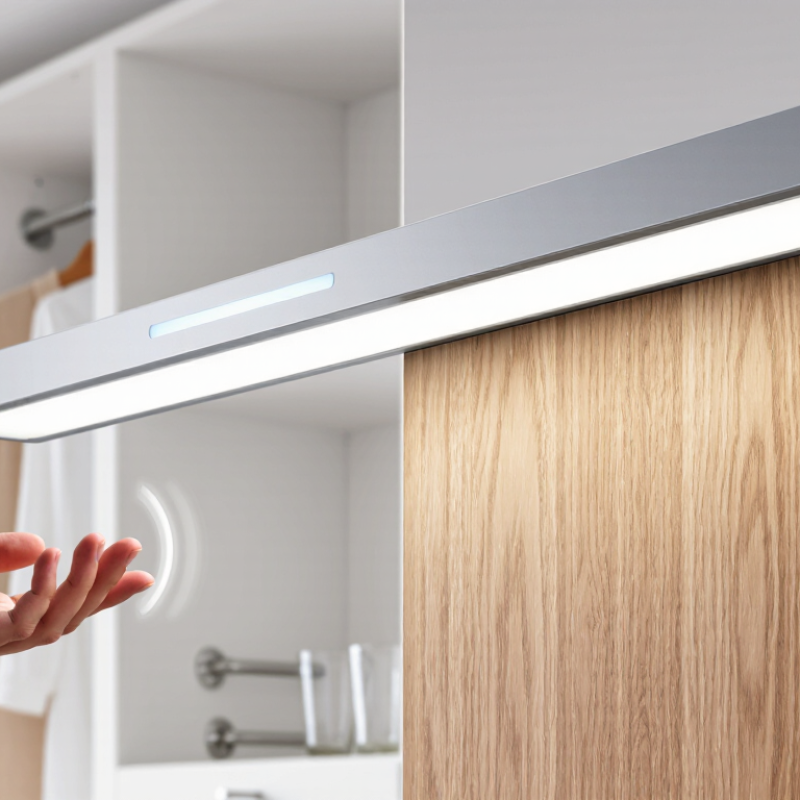
An induction cabinet light is a compact LED fixture that turns on when it detects movement, a nearby hand, or an opened door. “Induction” usually means sensor activation, not electrical induction. Most models use passive infrared sensors, microwave sensors, or magnetic door switches. A PIR sensor detects body heat and motion. A door sensor responds when the cabinet opens. Some products combine both methods.
The light normally includes an LED board, rechargeable battery, sensor, diffuser, and control circuit. Brightness may range from 50 to 300 lumens, depending on cabinet depth and task needs. A warm 2700–3000K color temperature suits bedrooms and wardrobes. A neutral 4000K option reveals food labels and hardware more clearly. The U.S. Department of Energy reports that LEDs use at least 75% less energy than incandescent lighting and can last up to 25 times longer. That figure applies to LED lighting generally, not every cabinet fixture.
Sensor quality matters in daily use. False triggers waste battery power. Weak detection leaves hands in shadow. Research from Lawrence Berkeley National Laboratory has found occupancy controls can reduce lighting energy use, although savings vary by room and behavior. The term “induction cabinet light” is not perfectly standardized, which can confuse buyers. Check sensing distance, standby current, battery capacity, color rendering, and installation method. A simple test helps: open the door repeatedly, move slowly, and inspect the corners. Small oversights appear quickly.
| Evaluation Dimension | Typical Specification or Option | What It Means for Global Buyers |
|---|---|---|
| Product Definition | An induction cabinet light is a compact light fixture that switches on automatically when its sensor detects motion, hand movement, or a nearby presence. | It provides hands-free illumination for kitchen cabinets, wardrobes, closets, pantries, display cabinets, hallways, and other enclosed or low-light areas. |
| Sensor Type | Common options include infrared motion sensing, hand-wave sensing, and door-triggered sensing. | Infrared sensing is suitable for general movement detection, while hand-wave sensing helps prevent accidental activation during daily use. |
| Detection Distance | Typically about 2–5 m for infrared motion sensors; hand-wave sensors usually operate within approximately 3–10 cm. | The required distance depends on cabinet depth, mounting position, and whether the light is intended for room entry or close-range operation. |
| Light Source | Integrated LED, generally using energy-efficient surface-mounted or linear LED modules. | LED technology offers low heat output, long operating life, and a slim form factor suitable for cabinet installation. |
| Power Options | Rechargeable battery models commonly use a 3.7 V lithium battery; hardwired models commonly use low-voltage DC input such as 5 V, 12 V, or 24 V. | Battery models simplify installation, while wired models are better for continuous operation in commercial projects or frequently used cabinets. |
| Battery Capacity | Rechargeable versions commonly range from approximately 500 mAh to 2,000 mAh, depending on product length and brightness. | Higher capacity can extend operation between charges, but it may increase product thickness, weight, and charging time. |
| Charging Interface | USB-C and Micro-USB are common on rechargeable models; some products use a dedicated low-voltage charging connector. | USB-C is generally more convenient for international users because compatible chargers and cables are widely available. |
| Power Consumption | Typical cabinet-light power ratings range from approximately 1 W to 8 W, depending on length and brightness. | Lower power consumption reduces battery drain and operating cost, especially when the sensor is configured to turn the light off automatically. |
| Brightness | Small cabinet lights commonly provide approximately 100–500 lumens; longer or wired fixtures may provide more. | About 100–200 lumens is often adequate for a small cabinet, while larger work areas may require higher output or multiple fixtures. |
| Color Temperature | Common choices include warm white at 2700–3000 K, neutral white at 3500–4500 K, and cool white at 5000–6500 K. | Warm white creates a comfortable residential atmosphere, while neutral or cool white can improve visibility for food preparation and storage areas. |
| Color Rendering Index | Many general-purpose models offer CRI 80 or higher; CRI 90 or higher is preferred where accurate color appearance is important. | A higher CRI helps users distinguish food, clothing, wood, and interior finishes more accurately under the light. |
| Dimming Function | Available functions may include multi-level brightness control, continuous dimming, or fixed brightness. | Dimming allows users to balance visual comfort, power consumption, and battery runtime. |
| Automatic Shut-Off | Common shut-off periods include approximately 15 seconds to 5 minutes after no movement is detected. | Automatic shut-off helps prevent unnecessary energy use and is especially useful for battery-powered installations. |
| Operating Voltage | Battery-powered products commonly operate at low internal voltage; wired products often use 5 V, 12 V, or 24 V DC. | Low-voltage products can simplify installation, but buyers should confirm adapter compatibility, plug type, and regional electrical requirements. |
| Ingress Protection | Indoor cabinet lights may have no formal water-resistance rating or may be rated around IP20; moisture-prone locations require a higher rating. | IP ratings should be checked before installation near sinks, bathrooms, laundry areas, or other locations exposed to water or condensation. |
| Fixture Length | Common lengths range from approximately 20 cm to 100 cm, with slim bar designs used for linear cabinet illumination. | The selected length should match the cabinet width and desired light distribution; multiple shorter fixtures can reduce dark spots. |
| Installation Method | Typical methods include magnetic mounting, adhesive backing, screws, clips, or recessed installation. | Magnetic and adhesive mounting support quick installation, while screw-mounted or recessed solutions are generally more secure for permanent projects. |
| Housing Materials | Common materials include aluminum alloy, polycarbonate, ABS, and acrylic light covers. | Aluminum can improve heat dissipation, while polycarbonate and acrylic are commonly used for lightweight diffusers and protective covers. |
| Typical LED Service Life | LED modules are often rated for approximately 25,000–50,000 hours under specified operating conditions. | Actual service life depends on heat management, driver quality, switching frequency, ambient temperature, and usage conditions. |
| Operating Environment | Many indoor models are designed for approximately 0°C to 40°C, although the exact range varies by product. | Buyers should verify the specified temperature range for installations in unheated storage rooms, vehicles, or hot commercial environments. |
| Best Use Cases | Kitchen cabinets, wardrobes, shoe cabinets, bookshelves, pantry shelves, display cabinets, corridors, and bedside storage. | Sensor cabinet lights are most useful where conventional wall switches are inconvenient, unavailable, or visually intrusive. |
| Key Buying Priorities for 2026 | Reliable sensor response, suitable brightness, USB-C charging, adequate battery capacity, strong mounting, low standby consumption, and appropriate electrical compliance. | Buyers should select specifications according to installation location and usage frequency rather than choosing only by brightness or appearance. |