inquiry
Leave Your Message

How to Find the Best China Strip Light Manufacturer?

Finding the best China Strip Light manufacturer requires more than comparing online prices. A polished catalog may still hide weak testing, inconsistent LEDs, or unclear warranty terms. Look for a supplier with verifiable factory information, stable export experience, and transparent production records. Ask where the LED chips, aluminum profiles, drivers, and controllers are sourced. These details affect brightness, heat control, service life, and installation safety.

Request product samples before discussing large orders. Test the Strip Light in a realistic setting, such as beneath a kitchen cabinet or inside a retail display. Check color consistency, adhesive strength, soldering quality, dimming performance, and heat after several hours. A professional manufacturer should provide photometric data, voltage options, IP ratings, and relevant compliance documents. However, documents alone are not enough. Independent verification still matters. Consider a factory video audit or an in-person inspection when the order is substantial.

Communication reveals practical reliability. Can the supplier explain lead times clearly? Can they identify production risks before you ask? A strong partner should confirm packaging details, replacement procedures, quality standards, and payment conditions in writing. Smaller factories may offer flexibility, but their quality systems might be less mature. Large manufacturers may provide stronger testing, yet their minimum order quantities can be restrictive.

There is no perfect checklist.

Compare real evidence, not promises. The right China manufacturer should balance engineering capability, consistent quality, responsive service, and reasonable pricing. More importantly, the supplier should help you prevent problems before the cartons leave the factory. That difference often separates a dependable long-term partner from an attractive but costly mistake.
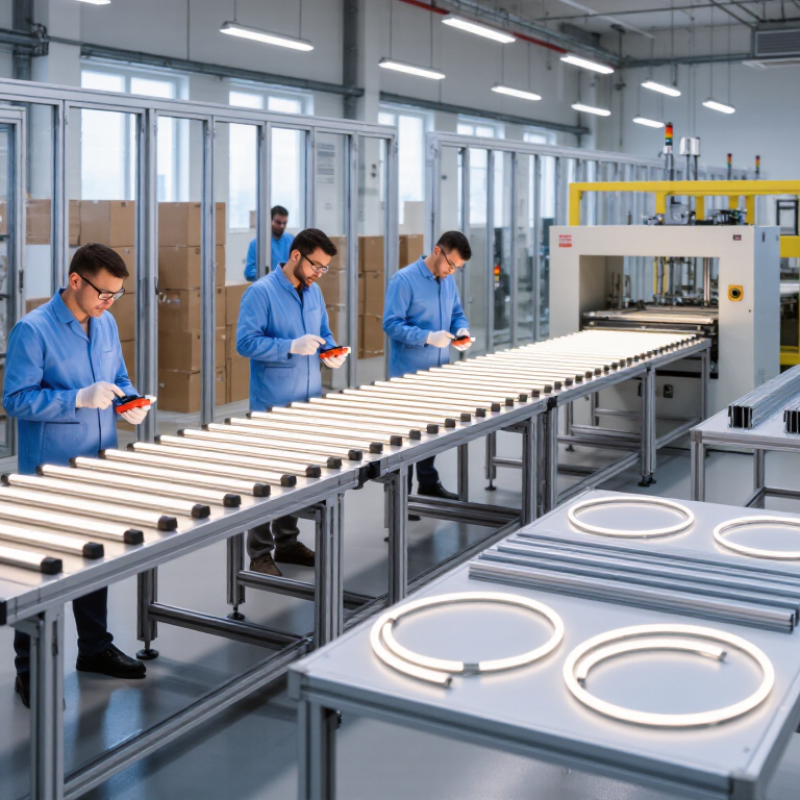
How to Find the Best China Strip Light Manufacturer?

Define Your Strip Light Requirements and Project Specifications

Choosing the best China strip light manufacturer starts with a precise project brief.

Define the installation location, total length, lighting purpose, and operating hours. Indoor shelving needs different protection than a damp exterior walkway. State the required IP rating, voltage, color temperature, brightness, and color rendering index. Details matter.

Measure twice. Record every corner, cut point, connector, and cable route. Specify whether the strip must bend vertically or horizontally. Calculate total wattage from actual length, then add about 20% power reserve. Long runs may require power injection to prevent visible brightness loss.

For a warm hospitality space, 2700K or 3000K may work well. Retail displays often need higher CRI and consistent color across every reel.

Ask manufacturers for samples made to your stated specifications, not generic samples. Test brightness, adhesive strength, heat behavior, dimming performance, and color consistency for several days. Request a clear datasheet, production tolerance, inspection records, and packaging details.

A reliable supplier should explain binning, PCB width, LED density, and warranty terms without vague promises. My early project mistake was trusting rated wattage without checking heat dissipation. The strip worked, but the aluminum profile was too shallow.

Reassess the profile, driver capacity, control system, and installation surface before approving mass production. Photos and drawings help, but a physical sample reveals problems that specifications sometimes hide.

Research China Strip Light Manufacturers and Their Product Capabilities

How to Find the Best China Strip Light Manufacturer?

Research China strip light manufacturers through verified product capabilities, not attractive catalogs. The International Energy Agency reported that LED lighting exceeded half of global lighting sales in 2022. This growth increases supplier competition and quality differences. Request factory evidence for LED binning, PCB design, soldering, waterproofing, and thermal management. A capable manufacturer should explain lumen output, CCT tolerance, CRI, voltage stability, and expected lifetime clearly.

Compare samples under identical conditions. Measure brightness, color consistency, surface temperature, power consumption, and dimming performance. The U.S. Department of Energy notes that LED performance depends strongly on thermal design and driver quality. Ask for LM-80 data, reliability test records, and batch inspection reports. Certificates alone are not enough. A polished sample may hide weak adhesive, uneven LEDs, or poor connector strength. Test it yourself.

Tips: Ask for a live production video and recent batch photos. Check whether the factory controls PCB assembly or outsources it. Confirm minimum order quantities, replacement policies, packaging tests, and lead times in writing. MarketsandMarkets projects continued growth in the LED lighting market, but forecasts cannot guarantee one supplier’s consistency. The best decision often needs a small pilot order. That takes longer. It reduces costly assumptions.

Evaluate Quality Standards, Certifications, and Production Capacity

A reliable China strip light manufacturer should prove quality through documents, samples, and repeatable production records. The U.S. Department of Energy’s 2023 Solid-State Lighting R&D Opportunities report notes laboratory LED efficacies above 200 lumens per watt. Finished strip systems usually perform lower because of heat, optics, drivers, and circuit losses. Request LM-80 data for LED lifetime, TM-21 projections, and lumen-maintenance test results. These records reveal more than a bright sample.

Check compliance with IEC 60598-1 for general luminaire safety and IEC 62471 for photobiological risks. For flexible products, inspect insulation, solder joints, copper thickness, adhesive strength, and IP testing. ISO 9001 certification supports process control, but it does not guarantee excellent strip lights. That distinction matters. The Zhaga Consortium’s market studies also emphasize interoperability and standardized interfaces in LED products. Ask whether the supplier controls LED binning, color consistency, and incoming-material inspections.

Tips: Request a production video, not only factory photographs. Compare three samples from different batches. Ask for monthly output, aging-test duration, defect rates, and peak-season capacity. Verify certificates with the issuing organization. A supplier may quote impressive capacity, yet lack enough testing staff. I would also inspect a random reel after 500 hours. Small color shifts can appear late, and many buyers discover this too late.

How to Find the Best China Strip Light Manufacturer?

Use recognized quality standards, certifications, and verified production evidence when comparing strip light manufacturers. The chart below summarizes IEC 60529 water-protection levels commonly used for LED strip light applications.

How to read the chart: The second digit in an IP rating indicates water protection under IEC 60529. Higher levels provide stronger protection, but IP67 and IP68 products require correct sealing, connectors, and installation procedures.

Manufacturer Evaluation Checklist

  • Quality management: Request evidence of an ISO 9001 quality management system and documented inspection procedures.
  • Product protection: Confirm that the declared IP rating is supported by IEC 60529 test documentation for the complete strip, coating, connectors, and assembly.
  • Material compliance: Check RoHS documentation and the applicable CE Declaration of Conformity for products supplied to the European market.
  • Performance testing: Review LED binning, color consistency, electrical safety tests, thermal testing, and photometric reports.
  • Production capacity: Verify monthly output using production records, line capacity, staffing, inventory controls, quality-control checkpoints, and confirmed lead-time history.
  • Traceability: Require batch numbers, incoming-material records, aging-test results, and corrective-action reports for nonconforming products.

Compare Pricing, Customization Options, and Minimum Order Quantities

Finding the best China strip light manufacturer requires more than comparing the lowest quotation. Request itemized pricing for LEDs, aluminum profiles, power supplies, packaging, samples, and shipping terms. A low unit price may hide expensive tooling or weak testing. Ask whether prices change with order volume. Compare the same specifications, including brightness, color temperature, waterproof rating, and warranty period.

Customization can reveal a manufacturer’s real capabilities. Confirm whether they can adjust PCB width, LED density, cable length, adhesive backing, connectors, and packaging. Request drawings, sample photos, and a physical sample before approving production. I once focused too heavily on unit cost and overlooked a small tooling charge. That mistake changed the final budget. Technical details deserve equal attention.

Tips: Compare at least three written quotations. Check sample quality under continuous operation. Ask for the exact MOQ for standard and customized products. A lower MOQ may carry a higher price, while a larger MOQ can reduce costs but increase inventory risk. Clarify lead times, payment stages, inspection procedures, and replacement policies in writing. Do not rely only on polished catalogs. Supplier responses, test records, and consistent communication provide stronger evidence of reliability.

How to Find the Best China Strip Light Manufacturer? – Compare Pricing, Customization Options, and Minimum Order Quantities

The following comparison uses anonymized supplier profiles and typical China export-market quotations for LED strip lights. Actual prices may vary according to LED type, copper weight, waterproof rating, packaging, order volume, certifications, and shipping terms.

Supplier Profile Typical Product Range Indicative FOB Price
per Meter (USD)
Standard MOQ Customization Options Sample Lead Time Mass-Production Lead Time Best Fit
Profile A
Entry-Level OEM
SMD 2835 and 5050 strips; 12V and 24V; non-waterproof and IP65 versions $0.35–$1.20 500 meters per model PCB color, LED density, reel length, basic label, carton packaging 5–7 working days 15–25 working days Importers seeking competitive pricing for standard applications
Profile B
Flexible Custom Manufacturer
High-density, COB, RGB, RGBW, tunable-white, and side-emitting strips $0.80–$3.50 300 meters per specification Color temperature, LED layout, cut length, wire position, connectors, packaging, private label 7–10 working days 20–30 working days Brands requiring product differentiation and moderate order quantities
Profile C
Commercial-Grade Supplier
24V high-output strips, 2835/3014/3528/5050 options, aluminum-profile solutions $1.20–$4.80 1,000 meters per model High CRI, lumen output, thermal design, custom PCB, dimming compatibility, project packaging 7–12 working days 25–35 working days Commercial lighting projects and professional installers
Profile D
Waterproof Specialist
IP65, IP67, and IP68 silicone or sleeve-protected strips for indoor and outdoor use $1.10–$5.50 500 meters per IP specification Encapsulation material, waterproof connector, cable length, end caps, mounting clips, bending direction 10–14 working days 25–40 working days Outdoor, hospitality, architectural, and wet-location installations
Profile E
Smart Lighting Manufacturer
Wi-Fi, Bluetooth, SPI, DMX, addressable, RGBIC, and app-controlled LED strips $2.20–$8.00 1,000 meters or 500 control units Firmware, controller protocol, app interface, remote control, logo, retail packaging 12–18 working days 30–45 working days Smart-home distributors and connected-lighting projects
Profile F
Premium Retail-Ready Supplier
High-CRI, COB, neon-flex, complete kits, controllers, adapters, and installation accessories $2.50–$9.50 1,000 finished kits or 2,000 meters Retail box, multilingual instructions, barcode labels, accessories, color matching, bundled kits 10–15 working days 30–45 working days E-commerce, hardware retailers, and ready-to-sell product lines
Price Check
Compare the same voltage, LED density, color temperature, IP rating, copper weight, and packaging before selecting the lowest quotation.
Customization Check
Confirm whether engineering fees, tooling, printed packaging, firmware, connectors, and sample charges are included in the offer.
MOQ Check
Ask whether the MOQ applies per model, color, voltage, IP rating, reel length, or total purchase order.

Note: FOB quotations generally exclude international freight, insurance, import duties, taxes, certification fees, and destination charges. Request a current quotation, product specification sheet, test report, and pre-production sample before placing a bulk order.

Verify Samples, Communication, Lead Times, and After-Sales Support

Finding the best China strip light manufacturer requires more than comparing prices. Request production samples from the same batch, not polished showroom pieces. Test brightness, color temperature, CRI, adhesive strength, and voltage drop across five meters. The U.S. Department of Energy’s solid-state lighting reports stress that thermal management strongly affects LED performance and service life. Ask for LM-80 data, junction-temperature controls, and documented burn-in procedures. Samples should survive handling, bending, and several hours of continuous operation.

Communication reveals operational discipline. Ask one technical question about PCB width or IP rating, then assess the reply. Is it precise, timely, and supported by drawings? Slow answers may signal deeper delays. Lead times also need written detail: component purchasing, assembly, testing, packaging, and shipping. The 2023 World Bank Logistics Performance Index shows that international delivery reliability varies significantly by location and supply-chain capability. A quoted “15 days” means little without these stages.

After-sales support must be measurable. Request a defect policy, response time, replacement process, and spare-part availability. A practical agreement should define acceptable color variation, dead LEDs, solder defects, and warranty evidence. IEC 62717 provides performance guidance for LED modules, but compliance claims still require verification. I have seen buyers trust certificates too quickly. That is a mistake. Audit reports, video inspections, and independent testing reduce uncertainty, although they cannot remove it entirely. Keep a small reserve budget for rework; real projects rarely run perfectly.