+86 18968869621


In 2026, global buyers need more than a bright fixture. They need a Tri Proof Light that survives moisture, dust, vibration, and demanding operating schedules. A warehouse ceiling can hide condensation. A food-processing line can expose every sealing weakness. A parking structure can punish poor thermal design.
The International Energy Agency reports that lighting still represents about 15% of global electricity consumption. The U.S. Department of Energy also notes that LED systems can use up to 75% less energy and last much longer than traditional lamps. These figures explain the market’s direction. However, efficiency alone does not guarantee value. Buyers must examine lumen maintenance, power factor, flicker, beam distribution, operating temperature, and warranty conditions.
James Brodrick, former manager of the U.S. Department of Energy’s Solid-State Lighting program, has emphasized a practical principle: “Lighting quality must be judged in the application, not only on the specification sheet.” That warning matters. A laboratory result may not reflect a humid factory or a dusty logistics center.
This guide evaluates the 2026 Best Tri Proof Light options for international projects. It considers IP65 or IP66 protection, impact resistance, tested efficacy, safety certifications, installation details, and long-term service support. Regional requirements can differ. So can supplier honesty. Some product claims remain difficult to verify.
A perfect fixture does not exist. The right choice balances performance, compliance, cost, and maintenance risk. This comparison aims to make that decision clearer, while leaving room for careful questions.
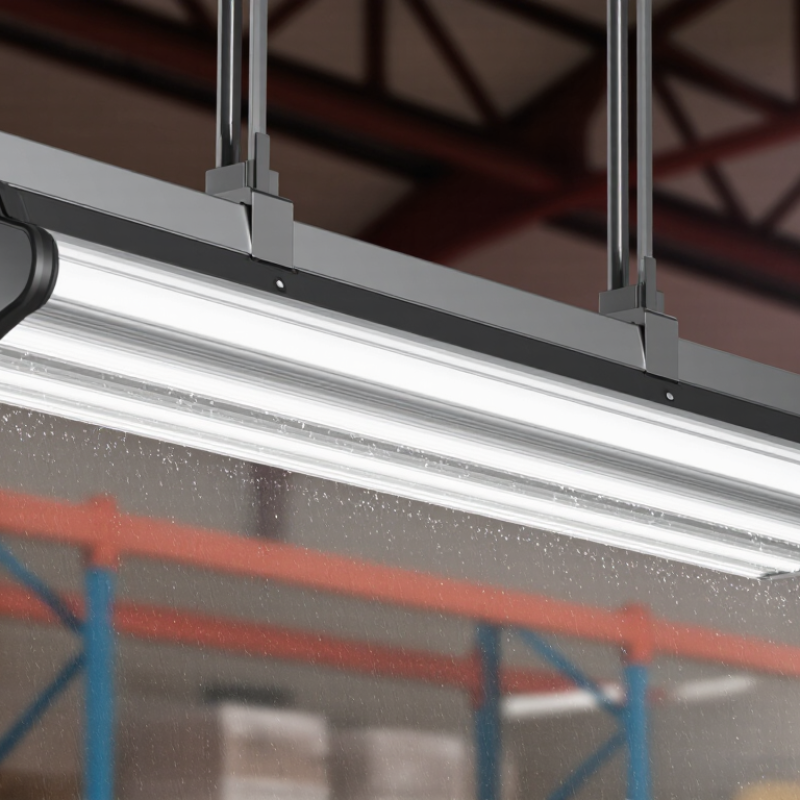
A tri-proof light is a sealed LED fixture designed to resist water, dust, corrosion, and impact. “Tri-proof” usually refers to waterproof, dustproof, and corrosion-resistant construction. Some models also provide strong impact protection. A polycarbonate housing, silicone gasket, and sealed end caps protect the internal driver and LED board. When powered, the driver converts incoming electricity into stable current, while the LED chips produce light with low heat output.
Ingress protection matters. IP65 blocks dust and protects against water jets, while IP66 offers stronger water-jet resistance. The exact rating must be verified through test documentation, not printed claims alone. The International Electrotechnical Commission defines these IP tests in IEC 60529. For demanding workshops, parking areas, or food-processing corridors, buyers should also check the IK impact rating, operating temperature, surge protection, and emergency-light compatibility.
Performance data needs careful reading. The U.S. Department of Energy’s 2023 Solid-State Lighting R&D Opportunities report records laboratory LED efficacies above 200 lumens per watt, but commercial fixtures often deliver less after optics, drivers, and thermal losses. That gap is important. A practical selection may target 120–160 lumens per watt, a five-year warranty, and verified lifetime testing. The DesignLights Consortium’s technical requirements also show why efficacy, quality, and controllability should be assessed together. Yet, even a high-efficiency fixture can disappoint when glare, poor drainage, or incorrect mounting is ignored. Installation experience still matters.
For global buyers, a tri-proof light should be judged by measured performance, not attractive catalog claims. Compare ingress protection carefully. An IP65 rating resists dust and water jets, while IP66 offers stronger water protection. IK08 or higher is useful in workshops, parking areas, and logistics spaces.
Check wattage against delivered lumens, not input power alone. A practical target is around 120–160 lumens per watt, but test conditions can change the result. Confirm the color temperature, such as 4000K for offices or 5000K for industrial work areas. A CRI above 80 supports clearer color recognition. For inspection tasks, CRI 90 may be worth the extra cost. Small detail. Big difference.
Electrical compatibility needs equal attention. Verify the input range, frequency, power factor, and total harmonic distortion before ordering. Wide-voltage operation can simplify international installation, but it does not replace local compliance checks. Review surge protection, operating temperature, and rated life with actual test reports. Look for certified data, not only printed promises. Housing material, diffuser strength, connector quality, and mounting distance affect field reliability. I have seen efficient fixtures fail early because condensation entered through weak cable connections. That part is easy to overlook. Consider emergency versions, dimming controls, and motion sensors only when the site truly needs them. Extra functions can increase maintenance points and complicate replacement. Compare dimensions and wiring access with the existing installation before approving a large shipment.
Choosing the best tri-proof light for global applications starts with the installation environment, not the product label. A cold warehouse, humid tunnel, and food-processing room create different demands. Check the required IP rating for water and dust protection. For exposed areas, IP65 may be sufficient, while washdown zones may require higher protection. IK impact resistance also matters where forklifts or tools could strike the fixture.
Electrical compatibility deserves close attention. Confirm the local voltage, frequency, power factor, and surge protection before ordering. Wide-input models can support different markets, but they still need correct installation. Review emergency lighting requirements and available dimming methods. Color temperature affects comfort and visibility. Neutral white light often suits warehouses, parking areas, and workshops. High color rendering is useful where workers inspect products or wiring.
Certifications must match the destination country and application. A test report from one market may not satisfy another authority. Ask for current documentation, safety data, photometric files, and clear warranty terms. In practice, thermal performance can be overlooked. Heat trapped above a ceiling may shorten the driver’s life. Allow ventilation and inspect cable glands carefully. Small details matter.
I have seen specifications look excellent on paper, yet poor mounting caused water entry. That mistake is easy to repeat. Sample testing under real temperature, dust, vibration, and cleaning conditions gives stronger evidence than catalog claims. No option is perfect. The best choice balances safety, serviceability, light quality, energy use, and local compliance.
| Selection Dimension | Typical Options or Range | Recommended Choice for Global Applications | Why It Matters | Buyer Verification Point |
|---|---|---|---|---|
| Housing Protection | IP65, IP66, or IP67 | IP66 for general industrial and commercial use; IP67 where temporary immersion may occur | IP65 protects against dust and water jets. IP66 provides stronger protection against powerful water jets. IP67 adds protection against temporary immersion under specified test conditions. | Confirm that the complete assembled luminaire, including end caps, cable glands, connectors, and emergency accessories, has the stated IP rating. |
| Impact Resistance | IK08 to IK10 | IK08 for normal indoor areas; IK10 for warehouses, sports facilities, workshops, and exposed locations | Higher IK ratings indicate greater resistance to mechanical impact. This can reduce damage from tools, carts, equipment, or accidental contact. | Check the IK rating for the full fixture, not only for the polycarbonate diffuser. |
| Input Voltage | 220–240 V AC, 100–277 V AC, or 120–347 V AC | A wide-range driver, such as 100–277 V AC, for projects covering multiple countries | Electrical systems differ between regions. A wide input range can simplify sourcing and reduce the need for different models in one international project. | Verify rated frequency, surge protection, power factor, total harmonic distortion, and local electrical-code requirements. |
| Power Consumption | Approximately 20–80 W for common linear models | Select wattage according to mounting height, spacing, required illuminance, and lighting layout | Higher wattage does not automatically mean better lighting. Correct optical distribution and spacing are more important for energy efficiency and uniformity. | Compare system wattage, not only LED-board wattage, and request photometric files for lighting calculations. |
| Luminous Efficacy | Approximately 100–170 lm/W for current commercial products | At least 120 lm/W for energy-conscious projects, subject to application requirements | Higher efficacy can reduce electricity consumption while maintaining the required light level. Actual performance depends on driver, optics, temperature, and operating conditions. | Ask for tested system efficacy at the declared input power and operating temperature. |
| Color Temperature | 3000 K, 4000 K, 5000 K, or 6500 K | 4000 K for balanced commercial and industrial environments; 5000 K for task-focused areas | Lower color temperatures appear warmer, while higher color temperatures appear cooler. The selected CCT affects visual comfort, appearance, and task visibility. | Confirm the nominal CCT and color-consistency tolerance, preferably with a stated SDCM or MacAdam-step value. |
| Color Rendering | CRI or Ra 80+; CRI or Ra 90+ | CRI 80+ for warehouses and general industrial areas; CRI 90+ for retail, inspection, and color-sensitive work | Higher color rendering helps users distinguish colors more accurately. It may be unnecessary for basic storage areas but valuable for inspection and presentation spaces. | Check the reported Ra value and, where relevant, R9 performance for saturated red colors. |
| Diffuser Material | Polycarbonate, PMMA, or hybrid construction | UV-stabilized polycarbonate for impact-prone areas; PMMA where long-term optical clarity and chemical compatibility are priorities | Polycarbonate generally offers strong impact resistance. PMMA can provide good optical stability but may be more vulnerable to impact in some designs. | Confirm UV resistance, flame rating, chemical compatibility, and diffuser transmittance for the installation environment. |
| Operating Temperature | Commonly about -20°C to +45°C; specialized designs may cover wider ranges | Choose a rated range that covers both the lowest and highest actual ambient temperatures | Temperature affects LED output, driver reliability, component life, and emergency-battery performance. | Review the complete luminaire temperature rating, including the driver and battery, rather than relying only on the LED component rating. |
| LED Lifetime | L70 values commonly range from 50,000 to 100,000 hours | Use an independently supported L70 rating with a stated operating temperature and maintenance factor | L70 indicates the time until average light output is expected to reach 70% of initial output. It does not mean the fixture will stop working at that time. | Request LM-80 data for LED packages and TM-21 or equivalent lifetime calculations where available. |
| Driver Reliability | Standard, flicker-reduced, dimmable, emergency-compatible, or smart-control driver | Select a driver with suitable surge protection, power factor, thermal protection, and control compatibility | The driver strongly influences flicker, energy performance, service life, dimming behavior, and compatibility with local power conditions. | Verify power factor, THD, surge rating, standby power, dimming protocol, and replacement availability. |
| Surge Protection | Typically 1 kV, 2 kV, 4 kV, or higher, depending on design and test method | Use a higher surge rating for outdoor, high-bay, or unstable-grid applications, supported by a project risk assessment | Surge protection helps reduce damage caused by transient voltage events, but it cannot replace proper grounding and external protection where required. | Confirm whether the rating applies in common mode, differential mode, or both, and identify the applicable test standard. |
| Mounting Method | Surface mounting, suspension, trunking, chain, or continuous-row installation | Choose the mounting system that supports the required spacing, service access, and ceiling structure | Mounting height and orientation affect illuminance, glare, uniformity, cable routing, and maintenance time. | Check included brackets, suspension kits, mounting-hole spacing, cable-entry position, and allowable installation orientation. |
| Emergency Lighting | Not included, maintained emergency, non-maintained emergency, or central-battery compatible | Specify emergency operation only when required by the local building and life-safety design | Emergency requirements vary by country, building type, evacuation plan, and authority having jurisdiction. | Verify emergency duration, battery type, charging time, emergency output, test method, and certification for the destination market. |
| Controls and Connectivity | On/off, 0–10 V, DALI-2, microwave sensor, PIR sensor, or wireless control | Use the simplest control system that meets energy and automation requirements | Controls can reduce energy use through occupancy detection, daylight response, scheduling, or centralized management. | Confirm interoperability, sensor detection area, standby consumption, commissioning method, and cybersecurity requirements for connected systems. |
| Flicker Performance | Standard driver performance varies; low-flicker and flicker-free options are available | Use low-flicker performance in offices, inspection areas, education facilities, and locations with rotating machinery | Visible or invisible temporal light modulation may affect comfort, camera recording, visual tasks, or machine-operation safety. | Request flicker metrics such as percent flicker and flicker index, plus an appropriate stroboscopic-effect measure. |
| Maintenance Strategy | Replaceable driver, replaceable LED module, sealed unit, or complete-fixture replacement | Prefer serviceable components for large installations where access costs are high | Maintenance design influences total cost of ownership, downtime, spare-parts planning, and waste generation. | Confirm spare-part availability, access procedure, compatibility of replacement components, and expected maintenance intervals. |
| Compliance Documentation | Electrical safety, electromagnetic compatibility, photobiological safety, RoHS, REACH, and market-specific requirements | Require a complete technical file matched to the destination country and project specification | International acceptance depends on the destination market, installation type, and applicable regulations. A single document is rarely sufficient for every region. | Check declarations, test reports, labeling, user instructions, traceability, and validity of certificates for the exact model and configuration. |
| Total Cost of Ownership | Purchase price, installation, electricity, maintenance, controls, replacement parts, and disposal | Compare lifecycle cost over the planned service period, not only initial unit price | A lower purchase price may result in higher energy use, more frequent maintenance, shorter driver life, or greater installation cost. | Use a consistent comparison based on operating hours, electricity tariff, light-output requirements, maintenance access, and expected service life. |

For global buyers, the best tri-proof light in 2026 must survive dust, water, and frequent temperature changes. Installation begins with the enclosure rating. IEC 60529 defines IP65 protection against dust and water jets, while IP66 adds stronger water-jet resistance. Select the rating according to the site, not the product photo. Mount fixtures with corrosion-resistant hardware and sealed cable glands. Leave service clearance above each fitting. A crowded ceiling complicates inspection.
Safety depends on more than brightness. The IEC 60598-1 standard requires general safety controls for luminaires, including insulation, temperature, and mechanical protection. Ask for current test reports, photometric files, and emergency-lighting documentation where applicable. IEA’s Energy Efficiency 2023 report identifies lighting as roughly 15% of global electricity consumption. Efficient LEDs can reduce operating demand, but poor thermal design shortens their useful life. Check the ambient-temperature rating. Heat still matters.
Maintenance teams should inspect seals, lenses, terminals, and mounting points at scheduled intervals. In food, logistics, and washdown areas, residue can hide small cracks. Clean lenses with a soft cloth and approved detergent; abrasive chemicals may damage the surface. Record failures by location and operating hours. This creates evidence for replacement decisions. A practical weakness remains: many buyers compare wattage first and installation labor last. That approach can inflate lifecycle cost. Reviewers should also question optimistic lifespan claims, because real conditions rarely match laboratory testing.
2026 Best Tri Proof Light for Global Buyers
Choosing a tri-proof light in 2026 requires more than checking brightness and price. Buyers should request test reports for IEC 60598 safety requirements, electromagnetic compatibility, and market-specific approvals. IP65 or IP66 protection helps resist dust and water, while IK08 impact protection suits warehouses, parking areas, and workshops. Requirements differ by destination. Confirm them before ordering.
Supplier quality is equally important. Ask for production samples, LED specifications, driver details, warranty terms, and batch traceability. A reliable supplier should explain temperature testing, aging tests, and photometric data clearly. Factory audits can reveal poor sealing, loose wiring, or inconsistent assembly. I have learned that attractive samples may hide weaker production batches. That risk deserves attention.
Tips: Compare total cost, not unit price. Include freight, import duties, installation labor, energy use, replacement rates, and disposal. A slightly cheaper lamp may consume more power or fail earlier. Request a five-year cost estimate using your operating hours and electricity rate. Check warranty exclusions carefully. Keep spare units for critical areas. Even careful planning can miss local labor costs, so leave a reasonable contingency.
IP65, IP66, IP67 and IP68 are defined by IEC 60529. The first digit indicates protection against solid particles, while the second digit indicates protection against water. IP65 and IP66 are commonly suitable for dusty industrial areas and wash-down environments; IP67 and IP68 add immersion protection, but the exact IP68 test conditions must be specified by the manufacturer. Buyers should also verify applicable electrical safety, EMC, RoHS and market-specific conformity requirements before comparing total cost.